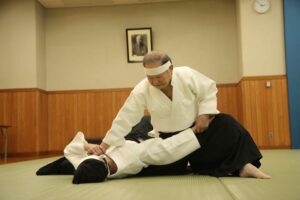
 Tenjin Shinyoryu (TSYR) is the most well known jujutsu school due to the founder of Kodokan Judo, Kano Jigoro, having learnt this system and used it as the base for judo. Several of the leading students of Kano were also trained in TSYR. Another famous student of TSYR was the founder of Aikido, Uyeshiba Morihei. There is a historical connection for the UK, with Manchester born EJ Harrison having travelled to Japan in 1897 and taken up TSYR before he joined the Kodokan. Koizumi Gunji, known as the father of British Judo, also practised TSYR around the same time as Harrison.
Wadoryu karate has a technical and historical connection with jujutsu too, especially the Yoshinryu lines of jujutsu. According to Otsuka Jiro, his father Otsuka Hironori, practised TSYR amongst several other jujutsu schools including Shinto Yoshinryu and Shinpen Igaryu. The Shinto Yoshinryu which Otsuka Hironori trained in his youth, was derived from TSYR and another famous school called Yoshin Koryu, so about half the techniques come directly from TSYR. Neither the Shinpen Igaryu nor Shinto Yoshinryu exist today and so the closest examples we have to the techniques trained in these schools are those of Iga Ryuha Katsushinryu and the TSYR.
TSYR is school established c.1815-1820 in Edo (old Tokyo). The founder was Iso Mataemon Masatomo, a samurai who worked in the Shogunate armoury and had previously studied two closely related grappling arts of Yoshinryu and Shin-no-Shintoryu. Iso merged what he thought were the most useful techniques combined with his practical experience and opened a dojo in the Kanda district of Tokyo. Even today, TSYR is still taught in the locality of his old dojo.
Iso passed the system down to his son and it continued through five generations, ending with the fifth Iso who died in 1945. Along the way, he and his ancestors taught thousands of students so that TSYR became quite widespread, both around Edo and across Japan.
TSYR comes from the Akiyama Yoshinryu line of jujutsu. One unique feature of Yoshinryu is the inclusion of medical knowledge both for the purpose of how to apply techniques effectively and also for healing. A lot of TSYR teachers used this medical knowledge taught in the school to earn an income as bonesetters. Bonesetters treated bone fractures and dislocations but often used other herbal remedies to treat illness using Chinese medicine. Because of this, TSYR teachers were able to maintain their dojo when other martial arts dojo were closing down in the Meiji era (1868 – 1912). In other words, the bonesetting practise (known as Sekkotsu) allowed TSYR to survive into the 20th century.
Tenjin Shinyoryu training method
TSYR practice begins with learning breakfalls (ukemi) similar to the method used in Judo. Once these are well learnt, practice moves to the first 12 techniques of Tehodoki – basics skills for releasing oneself from holds. After this, the techniques are taught in sets of seated and standing techniques, beginning with the Shodan Idori and Shodan Tachiai. This continues until the full curriculum of 124 forms are learnt. Each form is a pair kata in itself.
Our Dojo
We are connected to the Sakamoto line of TSYR jujutsu as a study branch and in the process of establishing a regular training session. The class is open to any adults with an interest in this old style of jujutsu and may be of particular interest for judo and aikido students interested in exploring the jujutsu roots of their school. If so, then please get in touch using our contact form to find out more.